|
|
Integrated Fall Practicum -
(Fall Camp)
An online tour of our fall camp facilities is available by clicking here
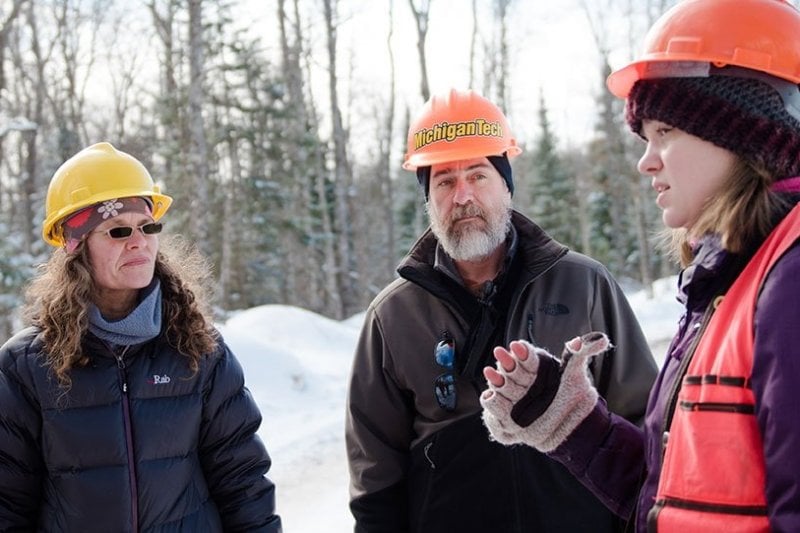
Fall Camp at Michigan Tech is a unique experience that blends classroom study
with hands-on, field-based learning opportunities. This semester-long field
practicum is designed for forestry and applied ecology students and promotes
teamwork, increases competency in the woods, challenges you both mentally
and physically, and prepares you for a career in forestry or applied ecology.
|
Mission Statement
The mission
of the fall field practicum is to provide students with extensive knowledge
of the elements of a forested landscape and the methods
of quantification this landscape. These include not only trees and non-woody
plants, but wildlife, fungi, and insects, in addition to the abiotic components
such as soil, water, weather, and climate. Students in both degree programs
become proficient in practical timber measurement and forest descriptive
skills. . In the process of measuring and describing the forest, students
will also gain insight into other forest values and ecological processes
that are vital to the resource assessment and complete management of natural
resources.
|
Forestry |
Applied Ecology & Wildlife Ecology |
|
|
|
|
|
|
| Fall
Camp Requirements for Forestry |
|
Course
# |
Course
Name |
Credits |
| FW3010 |
Silviculture |
4 |
| FW3150 |
Timber
Harvesting |
2 |
| FW3170 |
Land
Measurements and GPS |
1 |
| FW3190 |
Multiresource
Assessment |
3 |
| FW3600 |
Wildlife
Habitat |
3 |
| FW3840 |
Forest
Health |
3 |
| |
Total |
16 |
Forestry
Fall Camp Course Descriptions
FW3010
Practice of Silviculture
Methods of controlling the establishment, growth, composition, health,
and quality of forests and woodlands to meet the diverse needs and values
of landowners and society on a sustainable basis. Prerequisites: FW2010
and FW2050.
FW3150
Timber Harvesting
Methods and techniques used in timber harvesting systems. Emphasizes best
management practices and efficient allocation of resources in logging.
Prerequisite: FW2050.
FW3170
Land Measurements and GPS
Basic field measurements and computations involved in determining direction,
distance, and area. Covers the hand compass, pacing and use of global
positioning systems, including differential correction. Explores integration of GPS and
GIS data. Prerequisite: FW3540
FW3190
Multi-Resource Assessment
Students develop a basic proficiency in the application of multiple-resource
measurement techniques, become familiar with the application of individual
tree and landscape measurements, estimation of growth, sampling techniques,
computational procedures, and mapping procedures commonly used in forest
and land management. Prerequisites: FW2050, FW3020, MA2720.
FW3600
Wildlife Habitat
To understand the ecological basis for management of forest wildlife and
how forest management influences wildlife populations. Laboratory includes
an introduction to techniques in wildlife research and management, especially
methods of habitat analysis. Prerequisite: junior standing.
FW3840
Forest Health
Drawing on examples from the Great Lakes region, and other parts of North
American, this course will consider which type of insects and pathogens
attack our trees and forests, how they interact with each other, and what
tools we can use to effectively reduce their negative impacts of forest
pests. Prerequisites: FW3020
| Fall
Camp Requirements for Applied Ecology & Wildlife Ecology |
|
Course
# |
Course
Name |
Credits |
| FW3012 |
Survey of Silviculture |
2 |
| FW3170 |
Land Measurements
and GPS |
1 |
| FW3180 |
Geomorphology,
Landscapes and Ecosystems |
2 |
| FW3190 |
Multiresource Assessment |
3 |
| FW3600 |
Wildlife Habitat |
3 |
| FW3800 |
Insect Ecology |
2 |
| FW3840 |
Forest Health |
3 |
| |
Total |
16 |
Applied
Ecology & Wildlife Ecology Fall Camp Course Descriptions
FW3012
Survey of Silviculture
An introduction to the practice of silviculture, including ecological
principles, which form the basis for forest management. The course emphasizes
proper use of silviculture terminology, and includes field examples of
management practices.
FW3170
Land Measurements and GPS
Basic field measurements and computations involved in determining direction,
distance, and area. Covers the hand compass, pacing and use of global
positioning systems, including differential correction. Explores integration of GPS and
GIS data. Prerequisite: FW3540
FW3180
- Geomorphology, Landscapes and Ecosystems
Provides basic understanding of the geologic and glacial processes that
shaped the landscape of the Upper Midwest influencing the distribution
and productivity of modern-day plant communities. Topics include geology
of Michigan, glacial geomorphology, soil development, landscape and community
ecology, and forestry.
FW3190 Multi-Resource Assessment
Students develop a basic proficiency in the application of multiple-resource
measurement techniques, become familiar with the application of individual
tree and landscape measurements, estimation of growth, sampling techniques,
computational procedures, and mapping procedures commonly used in forest
and land management. Prerequisites: FW2050, FW3020, MA2720.
FW3600 Wildlife Habitat
Understand the ecological basis for management of forest wildlife and
how forest management influences wildlife populations. Laboratory introduces
techniques in wildlife research and management, especially methods of
habitat analysis. Prerequisite: junior standing
FW3800
Insect Ecology
Insects are widespread and diverse components of terrestrial and aquatic
ecosystems. This course will consider aspects of insect ecology, including
bio-diversity and conservation of insects, the effects of biotic and abiotic
factors on insect populations, and the trophic diversity of insects.
FW3840
Forest Health
Drawing on examples from the Great Lakes region, and other parts of North
American, this course will consider which type of insects and pathogens
attack our trees and forests, how they interact with each other, and what
tools we can use to effectively reduce their negative impacts of forest
pests. Prerequisites: FW3020
2011 IFP Information Packet
Last update:
March 17, 2011
|
| |