What's
so Special about Ecosystems of the Upper Peninsula of Michigan?
Today,
the Upper Peninsula of Michigan is heavily forested and filled with
wildlife of all kinds. To most people, it looks natural and pristine,
but it hasn't always been like this. In fact, the forests that you
see today are second and third generations that have regrown over
the last century. The ecosystems of the U.P. are different from
what would be here if the environment had not been disturbed humans,
but they also show how ecosystems are capable of being repaired
when they are managed more wisely and more carefully.
When
Michigan became a state in 1837, politicians sent surveyors to the
Upper Peninsula to map the land and its resources. What they found
were valuable White Pines and hardwood trees such as Maples, as
well as iron ore and copper. This brought thousands of American
and immigrant settlers who were hoping the logging and mining opportunities
would make them wealthy.
According to the Michigan Department of Natural Resources, intensive
logging, beginning with white pine in the late 1800's then moving
to northern hardwoods and other species has resulted in major changes
in forest types and composition.
Before nonnative settlers arrived, vegetation consisted
of diverse forests, including northern hardwood forest, jack pine
barrens, white pine-red pine forest, hardwood- conifer swamp, conifer
swamp and muskeg. Where bedrock was exposed at the surface, grassland
communities
were present, and extensive Great Lakes marshes were dominant along
the shoreline. Windthrow and fire were common and important natural
disturbances on the landscape. By the 1920s, though the iron and
copper were nearly gone and most of the UP's forests had been cleared.
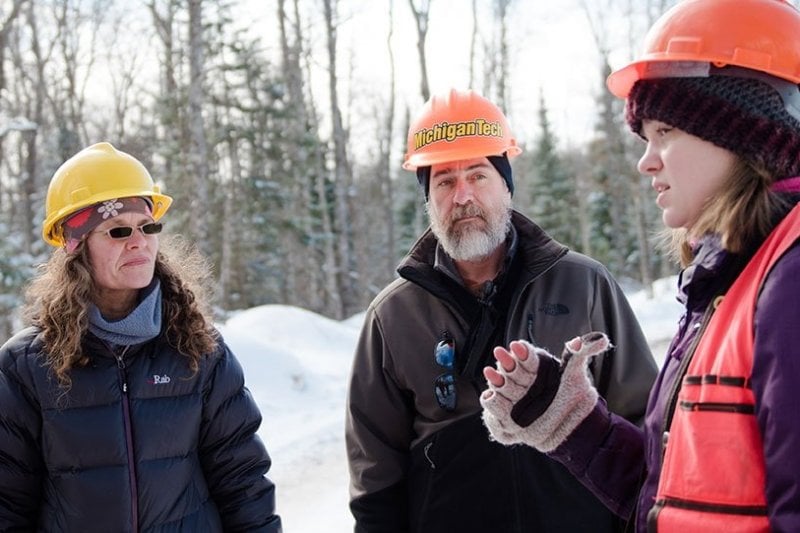
Today, the forest ecosystems of the U.P. are managed
by National and State biologists
and ecologists, as well as professional foresters. Even though logging
continues and always has an impact on the ecosystems where it happens,
scientists and foresters are working to make logging sustainable.
They think about the importance of the wood supply, but they also
consider wildlife, habitat, water, plant biodiversity, and fire
protection. They realize that forests are important for timber,
but that they are also part of an ecosystem that all kinds of plants,
animals, micro-organisms, and people also depend on.
|