REU for Ecosystems in Transition - Home


Educational Training Sessions


Case Study Discussions


Independent Research Projects


Communicating Research Results


Career Exploration


Recreational Activities


Schedule for 2005


Application Forms


Mentors


Cooperating Research Projects


Travel and Lodging


REU Site for Ecosystems in Transition:

The Role of Research in Assessing Ecosystem Responses to a Changing Environment:


This program will not be held in 2008. 

We hope to resume the program in 2009. 


Cooperating Research Projects and Facilities:


All equipment needed to carry out the REU projects was available on campus at MTU or in the USDA Forest Service research lab adjacent to campus.  Several of the REU projects took advantage of major instrumentation recently purchased with NSF funds, including two mass spectrometers.   Field research facilities and long-term research projects were also be available for the students.  These included:


*  The Ford Center and School Research Forest, which is located forty miles south of the Michigan Tech campus. The Center is a 4,547 acre facility for research, education and outreach. Physical facilities designed to accommodate programs include a modern dormitory, individual houses, a dining hall, four classrooms, a large conference/meeting room, a computer lab and a sample processing lab.  A variety of forest ecosystems, including northern hardwoods, jack pine, natural red pine, and several wetland communities occur in the School Research Forest.  Both managed and natural stands are available, as are nearby old-growth reference forests in federal and state wilderness areas.  The School Research Forest is also home to the newly established Center for Restoration Silviculture.


*  The Michigan Gradient Study, which has examined the influence of global change factors (temperature, moisture, and chronic N inputs) on northern hardwood forests since 1987.  NSF has been the primary source of funding for this project during the past decade.  One of the study sites is located 26 miles from campus and all four sites were available for use by the REU students.


*  The Wolves and Moose of Isle Royale.   Isle Royale National Park is home to long-term studies of wolf-moose interactions,  their impacts on vegetation and ecosystem processes, and the influence of climatic variations on these interactions.  The investigation of wolves and moose represents the world's longest continuous study of either species (44 years and counting).  Mentors involved in this research have well-established field facilities and research locations on the island.  Rustic lodging that an REU student could use was available on the island, although camping at times was necessary. 


*  The Aspen FACE (FACTS II) Project in Rhinelander, WI (150 miles from campus).  This experiment is a multidisciplinary study to assess the effects of increasing tropospheric O3 and CO2 on aspen forest ecosystems.  Collaborators at the site include MTU, the USDA Forest Service, Brookhaven National Laboratory and thirteen additional universities and government institutions from the US and abroad.  NSF is among the agencies currently funding research at this facility - the only field study in the world examining the interactive effects of increasing concentrations of these two gases on C and nutrient cycling in a growing forest.  Several of our mentors have ongoing research at this facility and provided access to the facility for REU students and arranged lodging near the site.


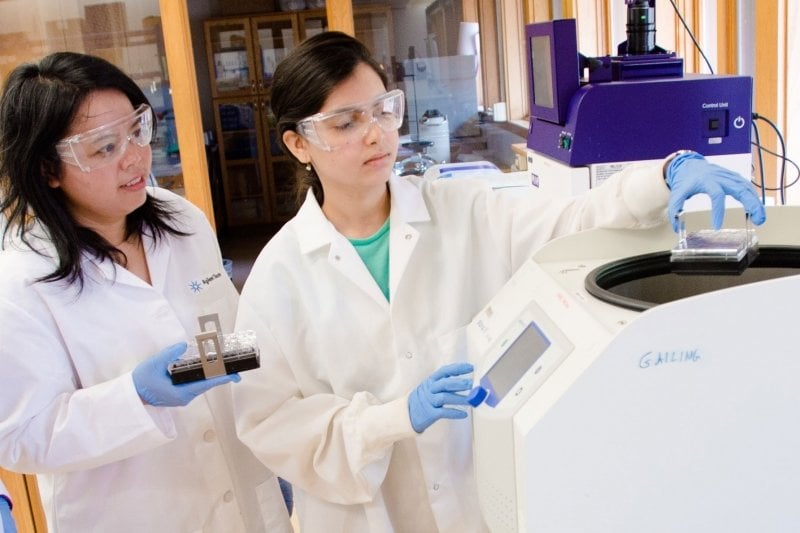
*  The Plant Biotechnology Research Center uses genetic engineering, molecular biology and bioinformatics as tools to understand tree properties that are key for improved wood production and conscientious forest stewardship.  This center within the SFRES has state-of-the-art instrumentation for performing cutting-edge research in forest biotechnology.  Center goals include improving tree productivity and investigating ecological molecular dynamics.  Dr. C. Joshi, one of the Center’s faculty and an REU mentor in 2004, has recently received a prestigious NSF CAREER award.


*  The USDA Forest Service Work Unit on “Belowground Processes that Sustain Productivity and Ecosystem Function in Northern Forests is located on the MTU campus, adjacent to the School of Forest Resources and Environmental Science.  Researches at the work unit seek to improve our understanding of the factors regulating carbon allocation to root systems, evaluate how belowground biogeochemical cycles and the biodiversity of soil organisms are being altered by human activities, and design management systems that stabilize or enhance ecosystem function and maintain biodiversity.  Their facilities include a laboratory building dedicated to studying belowground ecology, focusing on roots and mycorrhizae.  Two of the REU mentors are research ecologists at the work unit.